


Investment Thesis: Attractive Income Profile Offset by Structural Value Creation Challenges
Banco Bradesco BBD 0.00%↑ stands as Brazil’s second-largest private bank, controlling roughly 10–15% of deposits and holding a leading 20–25% share of the country’s insurance market. The institution also maintains a meaningful position in asset management and strengthened its footprint through the acquisition of HSBC’s Brazilian operations in 2016. With a current market capitalization of $43.26 billion and shares trading near $4, the stock offers a forward dividend yield of 5.2%, positioning it competitively within the banking sector.
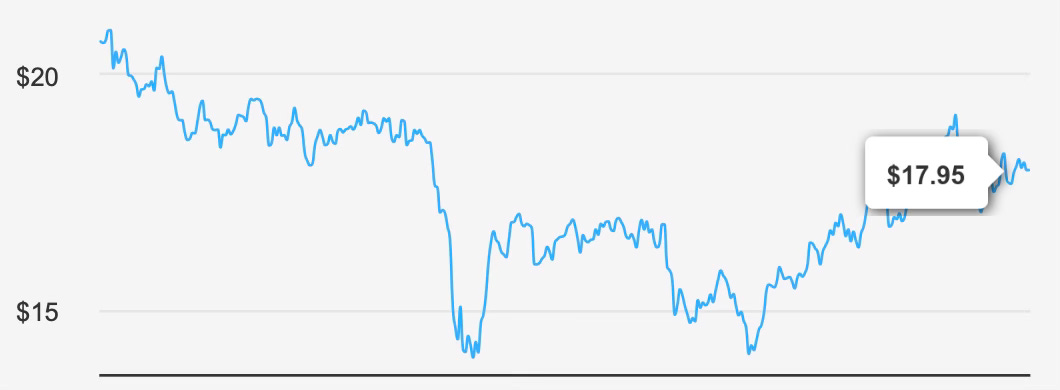
However, beneath the surface of its income appeal lies a more complex financial picture. The company is currently rated as modestly overvalued, with an intrinsic value estimated at $1.66 per share and a deeply negative margin of safety of -146.4%. That disconnect between price and underlying value is reinforced by fundamental performance metrics. Most notably, both five- and ten-year Return on Invested Capital figures are reported at 0.0%, while the five-year median Weighted Average Cost of Capital stands at 32.3%, only marginally below the current 32.1%.
This spread between return and cost of capital implies persistent economic value destruction. For long-term dividend investors, the central question is whether the bank’s income stream can compensate for this structural capital inefficiency. The dividend appears supported in the near term, but sustained shareholder value creation requires more than a high payout—it demands returns that exceed capital costs. At present, that condition is not being met.
Earnings Momentum and Profitability Trends: Growth Moderation and Capital Inefficiency
Banco Bradesco’s revenue growth has been steady but unspectacular. Over the past five years, revenue has expanded at an annual rate of 5.4%, while the ten-year growth rate stands at 3.7%. Asset growth has outpaced revenue, increasing at 8.5% annually, suggesting that incremental assets are not translating proportionally into higher top-line performance. This divergence raises concerns about balance sheet efficiency and capital deployment discipline.
The most striking issue remains profitability relative to capital structure. A 0.0% ROIC over both five- and ten-year periods indicates that invested capital has not generated measurable returns above accounting thresholds. When juxtaposed against a WACC exceeding 32%, the negative spread becomes difficult to ignore. In economic terms, this implies that each incremental unit of capital employed fails to clear the cost hurdle, eroding long-term shareholder value.
From a quality-of-earnings perspective, there are mitigating considerations. The Beneish M-Score suggests low risk of earnings manipulation, and revenue and earnings trends have been described as predictable. That predictability may offer some resilience in volatile macroeconomic conditions. Yet predictability without economic profitability does not equate to value creation.
Additionally, the company’s tax strategy—resulting in comparatively lower tax payments—has temporarily supported earnings. Should those benefits normalize, reported profitability could face incremental pressure. Combined with elevated capital costs, this dynamic narrows the margin for error in future operating performance.
Overall, while top-line expansion remains intact, profitability metrics reveal a structurally challenged return profile that undermines the investment case from a total-return perspective.
Dividend Profile and Sustainability: Competitive Yield with Moderating Growth Outlook
Banco Bradesco’s dividend history is one of consistent growth. Over the past five years, dividends have expanded at an average annual rate of 13.1%, while the three-year growth rate stands at 12.8%. These figures reflect a period of robust distribution increases and position the company favorably among income-oriented financial institutions.
Looking ahead, however, growth expectations are moderating. Forward projections suggest dividend growth of approximately 6.3% over the next three to five years. That deceleration likely reflects normalization in earnings expansion and a more measured capital allocation approach.
The forward dividend yield of 5.2% remains compelling. Importantly, the current payout ratio stands at 55.0%, a meaningful improvement from historical peaks above 100%. This moderation suggests a more balanced alignment between earnings generation and shareholder distributions. Dividend coverage is reported at 1.46, indicating that earnings exceed distributions by a reasonable margin.
Dividends are paid monthly, with the next ex-dividend date scheduled for March 4, 2026, and payment on March 9, 2026. The monthly cadence enhances income predictability and may appeal to investors seeking steady cash flow.
That said, sustainability ultimately depends on capital efficiency. If ROIC continues to lag far below WACC, long-term dividend growth could become constrained. While the current payout ratio appears manageable, sustained economic underperformance would gradually pressure distribution flexibility.
In short, the dividend today appears secure under existing conditions, but structural profitability challenges temper confidence in durable, above-inflation growth beyond the medium term.
Valuation Analysis and Margin of Safety Considerations: Yield Support Confronts Overvaluation Risk
At approximately $4 per share, Banco Bradesco trades at a level characterized as modestly overvalued, with intrinsic value estimated at $1.66. The implied margin of safety of -146.4% underscores a substantial disconnect between market pricing and underlying valuation metrics.
The stock is also trading near historical highs across several valuation benchmarks, including price-to-book, price-to-earnings, and price-to-sales ratios. While exact multiples are not specified, the directional signal suggests that investors are assigning premium valuations relative to historical norms.
Compounding this concern, the current dividend yield sits near a one-year low. When yield compresses amid elevated valuation ratios, it often indicates that price appreciation has outpaced underlying earnings and distribution growth.
For income-focused investors, the valuation debate hinges on whether a 5.2% forward yield justifies exposure to a bank generating returns materially below its cost of capital. In a lower-risk financial institution with strong ROIC, such a yield might represent attractive compensation. In this case, however, elevated capital costs and structural inefficiencies narrow the valuation cushion.
Absent meaningful improvement in return metrics or a material decline in share price, the stock offers limited margin of safety. Income support is evident, but total return potential appears constrained under current assumptions.
Risk Assessment and Capital Structure Considerations: Debt Issuance, Ownership Signals, and Market Activity
Over the past three years, Banco Bradesco has issued BRL 54.5 billion in new debt. While this level of indebtedness is described as acceptable, it contributes to an overall assessment of poor financial strength. Without a reported Debt-to-EBITDA ratio, leverage evaluation lacks precision, but incremental borrowing in a high-cost capital environment warrants scrutiny.
Ownership dynamics present additional considerations. Insider ownership stands at 0%, and no insider buying or selling activity has occurred over the past year. Institutional ownership is relatively low at 12%. The combination of minimal insider alignment and limited institutional participation may suggest restrained conviction among sophisticated stakeholders.
Liquidity, however, is strong. Average daily trading volume over the past two months is 35.8 million shares, while recent daily volume has reached 46.8 million shares, representing a 30.8% increase. The Dark Pool Index of 45.7% indicates that nearly half of trading activity occurs off public exchanges. While this may reflect institutional engagement, it can also affect price discovery dynamics.
Government contract activity has fluctuated, rising from $10 million to $50 million before easing to $40 million. Meanwhile, the company expanded its U.S. patent portfolio from a single patent in 2011 to 12 by 2018, signaling investment in intellectual property. These elements suggest ongoing strategic initiatives, though their financial impact remains secondary to core banking performance.
Collectively, leverage expansion, limited insider alignment, and capital inefficiency form the primary risk cluster. Liquidity strength and earnings predictability provide counterbalance but do not eliminate structural concerns.
Final Assessment
Banco Bradesco presents a clear income-versus-value tradeoff. The forward dividend yield of 5.2%, supported by a 55.0% payout ratio and 1.46 coverage, offers meaningful current income. Historical dividend growth has been robust, though forward expectations moderate to roughly 6% annually.
Yet the foundation beneath that income stream is challenged by a 0.0% ROIC against a WACC exceeding 32%, signaling sustained economic value destruction. With shares trading materially above estimated intrinsic value and valuation metrics near historical highs, the stock provides limited margin of safety.
For yield-oriented investors with tolerance for elevated risk and potential valuation compression, the dividend may remain attractive in the near term. However, for disciplined long-term dividend growth investors focused on capital efficiency and intrinsic value alignment, the risk-reward balance appears unfavorable at current levels.
In its present configuration, Banco Bradesco offers income stability but lacks the underlying return profile necessary to justify premium valuation. Until returns improve or valuation resets meaningfully lower, caution remains warranted despite the stock’s appealing yield.